Gentle Release Therapy®
Gentle, hands-on complementary therapy with its founder, Helen Robinson.
I developed Gentle Release Therapy through years of learning, exploring and bringing different approaches together. It's fully clothed, with light touch and nothing forced. You don't need to know how it works before you come, and there's no particular response you're expected to have. We'll begin with you, where you are, and take things from there.

It isn't a set routine. I listen to what you tell me, pay attention to what I notice, and draw on whatever feels right. You're involved throughout, and nothing needs to be forced.
I work slowly and gently. Nothing is pushed, and nothing is forced.
I pay attention to what I notice and how you respond, and let that guide the session.
You decide what feels comfortable. There is no rush, and nothing to prove.
More than one way of working
One of the things I love about Gentle Release is how much it has grown. Over time I've developed new aspects of it, often because something has come up while supporting myself, my family or a client.
These now include the Gentle Release Vagus Nerve® work, Gentle Release Spirit Points® and Gentle Release Ghost Points, alongside the gentle techniques listed here. There are other ideas I'm still exploring, too.
I teach some of these as courses for practitioners. But in a treatment with me they aren't separate boxes. I bring in whatever feels right, and you don't have to choose the technique. There's no attunement and no ritual.
In Traditional Chinese Medicine, different emotions are associated with different organs: grief with the lungs, fear with the kidneys, frustration and anger with the liver, all connected together like a web.
Softening tension at the head and jaw, working in synergy with the abdominal releases. The touch is light, and there is no manipulation.
Held over the organs of the chest and abdomen, following where emotions tend to settle. No needles, no pressure.
Gentle work informed by my training in endocrine and lymphatic approaches, given space, time and attention.
Throughout every session, I go slowly and make sure you feel comfortable and at ease.
Mostly, because of life
Women, men and children all come to Gentle Release, through menopause, alongside cancer treatment, as neurodivergent adults and children, through grief, or simply because life has been a lot. We'll always think about your circumstances, any medical care you're having, and whether this is right for you. Many arrive feeling:
Simpler than people expect
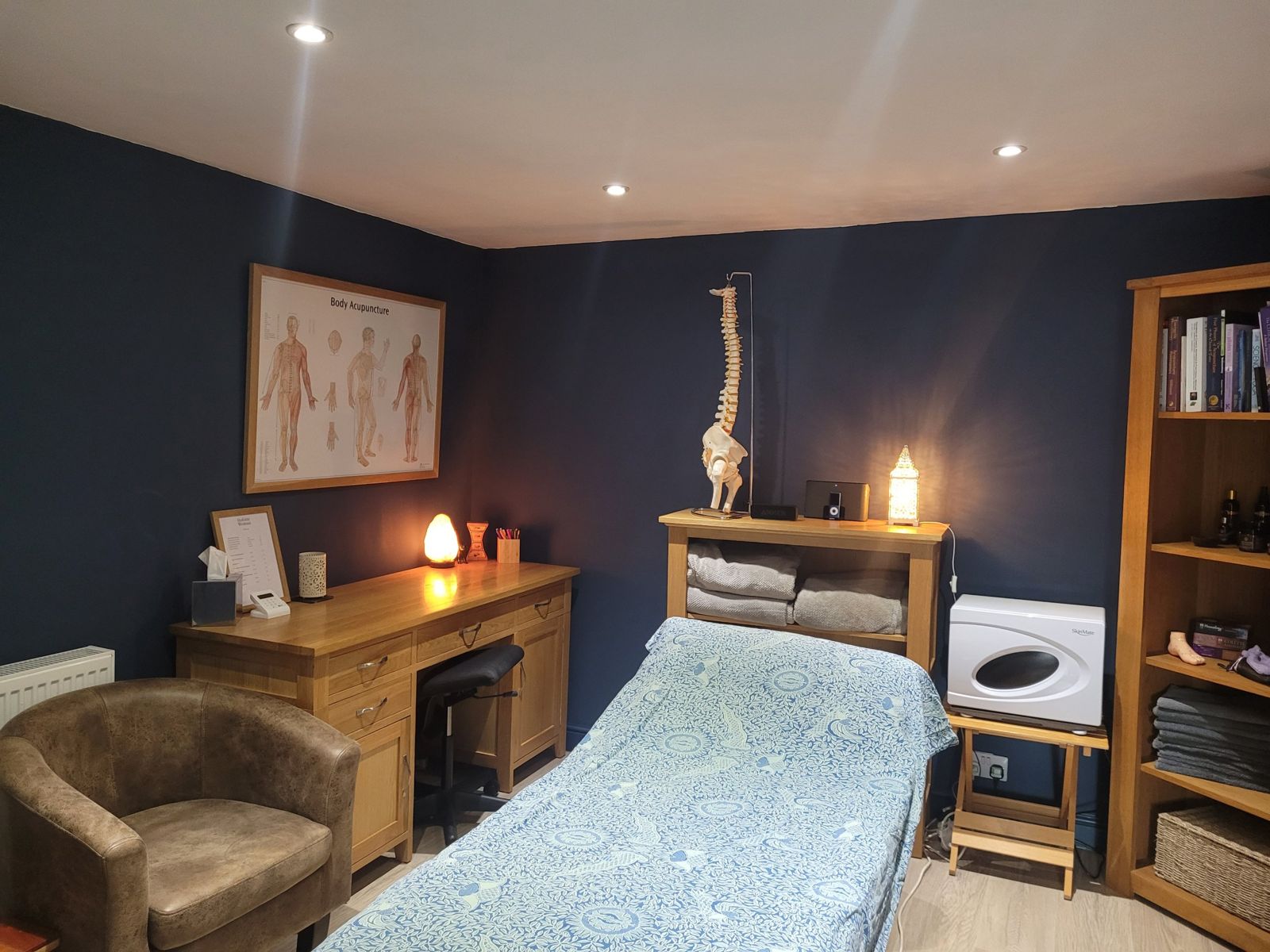
Sessions can be in person in Scothern, or at a distance with you resting comfortably at home. Many people are surprised by how present a distance session still feels.
You take your shoes off and settle in with a short, gentle catch-up. Share what feels useful, and nothing you'd rather keep private. Then you get comfortable, fully clothed, lying down, sitting, in a wheelchair, or even with a baby in arms.
My hands rest gently at the head and jaw, the neck, the spine, the abdomen and the feet. The touch is light, held with weight rather than pressure. You can talk, or drift off to sleep. You might yawn, sigh or feel a small wave of emotion pass, or you may notice nothing at all, and that's absolutely fine.
Everyone experiences it differently. Some people tell me they feel deeply relaxed, others pleasantly tired, and some notice very little at the time. There isn't a particular response you're supposed to have. Drink plenty of water, and keep the day a little lighter if you can.
Is this right for you?
I tend to work best with people who are open-minded and curious, and happy to see where a treatment takes us.
You certainly don't have to be spiritual, although if you are, you'll probably feel very much at home here! Some of the approaches I use draw on traditional ideas about energy, emotions and the connection between mind and body. Others are more focused on the physical body. I bring them together in whatever way feels right for you.
I work intuitively, and I'm comfortable talking about energy, meridians or what I'm noticing during a session, if that interests you. I'll never insist on it, though. You're always welcome to ask what I'm doing, or simply rest.
Treatments can sometimes be quite different from what people expect. You might find yourself feeling emotional, laughing, crying, noticing unusual sensations, or simply drifting off into a lovely deep rest. Equally, you might not notice very much happening at all. There's no right or wrong way to experience a session.
I'm very comfortable with whatever comes up, and you don't need to feel embarrassed or explain yourself. We can talk about things if you'd like to, or we can simply let you rest.
If you'd prefer a treatment that follows exactly the same steps every time, I might not be the best fit for you, and that's absolutely fine. My sessions tend to unfold as we go.
I don't expect you to believe in anything in particular. Just come with an open mind, and we'll see where we go.
“I came full of nerves and cynicism, but Helen's approach and lovely nature meant that I relaxed quickly.”
Begin with one, and see how it feels
Most people begin with a single session. If it feels right, there are different ways it can unfold from there.
A gentle introduction, and a chance to experience Gentle Release for yourself. Some people come once and find that is enough for that moment in time.
With more time, the body can settle further. A two-hour session in particular has a different quality, unhurried and spacious, with room for whatever is ready to unfold.
For when the body would appreciate the chance to settle, layer by layer. Best kept fairly close together, ideally within a month or so. No pressure to complete all seven, and no promise attached to a number.
You pay as you go: £100 for each of your first six sessions. If all seven are taken within three months, your seventh is £20 (a saving of £80). You're free to stop at any point; you simply wouldn't have the reduced seventh session.
A structured four-session approach I developed with Sara Agnew, using gentle techniques around areas associated with the vagus nerve and the stress response, moving through the ventral, dorsal, brain and HPA axis areas. You might be drawn to this if your nervous system has felt switched on for a long time. Read how the protocol came about
Gentle work with twelve points traditionally associated with emotional clarity, reconnection and a sense of direction, accessed through awareness, intention and light touch rather than needles.
A nurturing facial with gua sha, jade rolling, facial cupping and warm towels, brought together with the cranial and abdominal release at the heart of Gentle Release.
Distance sessions, with you resting comfortably at home, are £95 for an hour, £140 for an hour and a half, or £185 for two hours. Children's sessions are also available: 30 minutes £35, or 50 minutes £60.
Gently adapted to you
Some of us feel the world more strongly. If you are highly sensitive, or you or your child are neurodivergent, an ordinary treatment room can be a lot. Sessions can be shaped around all of that, so the experience feels safe rather than overwhelming.
Above all, this is a space without judgement. You are met exactly as you are.
You are welcome exactly as you are.

A few things people ask
Not at all. You're welcome exactly as you are, with all your curiosity and any of your doubts.
Both are forms of energy work, but Gentle Release is more specific and structured, drawing on Traditional Chinese Medicine and the body's own systems. There's no attunement and no ritual. Read the fuller answer on the blog
Both are perfectly alright. Some people become emotional during a session and others don't, and a quiet experience is every bit as valid.
Yes. Gentle Release sits comfortably alongside other care, including medical treatment. It's a complement, never a replacement.
Yes. The work is gentle enough for children and babies, and many find it soothing.
A note about my approach: Gentle Release draws on Traditional Chinese Medicine and ideas about energy. These are how I understand and practise the work, rather than established medical explanations, and I offer it to support relaxation and wellbeing alongside your medical care.
There are times in life when nothing needs fixing. We simply need somewhere gentle to land.
If you'd like to understand the work a little more first, the booklet is a gentle place to start. Or, when the time feels right, you're very welcome to book.
Interested in training? Learn Gentle Release at gentlereleasetherapy.com